
Wheel Alignment Riverton WY
Precision Wheel Alignment in Riverton, Wyoming
Maintain straight-line highway stability, maximize tire longevity, and protect your vehicle's steering components with certified wheel alignment service at Fremont Ford Riverton.
Driving across Fremont County places severe demands on your vehicle's steering and suspension geometry. From routine commutes along North Federal Boulevard and West Main Street to navigating heavy gravel county roads, cattle guards, and rough winter freeze-thaw cycles on US-26 and WY-789, your alignment angles gradually drift out of factory specifications. Our factory-trained Ford service technicians restore factory tolerances using computerized three-dimensional optical alignment equipment tailored for Ford trucks, commercial work vehicles, and passenger SUVs.
Why Proper Alignment Matters Across Fremont County Roads
Wheel alignment refers to the precise mechanical adjustment of your vehicle's steering and suspension components to orient your wheels perpendicular to the ground and parallel to each other. When your vehicle travels down Wyoming roads, properly aligned wheels minimize rolling resistance, preserve even tire tread contact, and maintain effortless steering control.
The Impact of Wyoming Terrain on Steering and Suspension Geometry
Motorists in Riverton, Lander, Shoshoni, and the Wind River basin face unique environmental factors that hasten suspension misalignment. Severe winter temperatures create deep asphalt frost heaves and potholes along rural Fremont County highways. Heavy agricultural hauling, horse trailer transport over washboard dirt roads, and crossing ranch cattle guards subject tie rod ends, ball joints, and control arm bushings to repeated high-impact shock loads. Even a single encounter with an unseen pothole on Eight Mile Road or Riverview Road can displace alignment settings by fractions of a degree, leading to accelerated tire damage and compromised braking control.
Extended Tire Tread Life
Misaligned tires drag across the road surface at an incorrect angle, scrubbing away valuable rubber tread. Restoring correct toe and camber specifications balances road friction evenly across all tread ribs, helping your tires achieve their full mileage potential.
Improved Road Stability and Tracking
Proper caster and toe alignment prevents your truck or SUV from wandering, pulling toward the shoulder, or drifting in crosswinds when traveling at highway speeds along US-26 between Riverton and Casper.
Reduced Mechanical Strain
When your wheels fight against each other due to improper thrust or toe angles, constant stress travels through the steering gear, wheel bearings, and suspension linkages. Timely alignment adjustments prevent premature component fatigue.
Understanding Wheel Alignment Angles: Camber, Caster, and Toe
During a professional wheel alignment inspection at Fremont Ford Riverton, our technicians evaluate four primary angular relationships. Each geometric setting controls specific vehicle handling characteristics and tire wear patterns.
| Alignment Angle | Mechanical Definition | Symptom When Out of Specification | Correction Method |
|---|---|---|---|
| Camber | Inward or outward tilt of the tire when viewed directly from the front of the vehicle. Negative camber tilts the top inward; positive camber tilts the top outward. | Rapid wear along the inner or outer tread shoulder of the tire, accompanied by a lateral pull toward the side with more positive camber. | Adjusting upper or lower control arm eccentric bolts, shims, or strut mount locations to establish flat tire tread contact. |
| Caster | Forward or rearward tilt of the steering axis pivot when viewed from the side of the vehicle. Positive caster positions the pivot line ahead of the tire contact patch. | Light, wandering steering feedback at highway speeds, poor steering wheel return-to-center after turns, or pulling toward the side with less positive caster. | Adjusting radius arm bushings, control arm cams, or strut mounts to balance high-speed directional stability and effortless steering feel. |
| Toe (Toe-In / Toe-Out) | The direction the tires point relative to the vehicle centerline when viewed from directly above. Toe-in points tires inward toward each other; toe-out points outward. | Severe tire tread feathering with sharp sawtooth edges across the tread blocks. Incorrect toe is the single fastest cause of catastrophic tire wear. | Adjusting inner and outer tie rod sleeve lengths to position the front and rear wheels parallel to the vehicle centerline. |
| Thrust Angle | The geometric line perpendicular to the rear axle relative to the vehicle center line, determining the direction the rear wheels push the chassis. | The vehicle travels down the highway crooked or sideways in a condition known as dog-tracking, requiring the driver to hold the steering wheel crooked to drive straight. | Aligning rear independent suspension links or repositioning rear axle leaf spring centering pins and u-bolts on trucks. |
Camber Angle and Shoulder Tire Wear
Camber controls how evenly tire tread contacts the pavement while cornering and driving straight. On Ford trucks carrying heavy payloads or snow plows in Fremont County, excessive front-end weight compresses suspension springs and forces the front wheels into negative camber. This causes the inner edges of the tires to wear down to the steel belts prematurely, even while the outer tread appears relatively untouched.
Caster Angle and Straight-Line Highway Stability
Caster angle functions similarly to the angled front fork on a bicycle. Positive caster stabilizes the steering wheel, providing that reassuring straight-line tracking when traveling long stretches of Wyoming highway. If caster angles become uneven between the left and right wheels due to a curb strike or pothole impact, the vehicle will pull firmly toward the side with less positive caster.
Toe Alignment and Tread Feathering Prevention
Even a small fraction of an inch in toe error produces destructive scrubbing. A tire that is misaligned by merely one-eighth of an inch is mechanically equivalent to dragging that tire sideways for miles down the road. Our certified technicians use optical laser targets to adjust tie rod linkages to factory tolerances down to the hundredth of an inch.
Warning Signs Your Truck or SUV Needs Wheel Alignment
Suspension misalignment frequently develops gradually, making it easy for drivers to adapt to worsening handling until significant tire damage has already occurred. Watch for these common operational symptoms during your daily driving in Riverton:
Steering Pull on Straight Roads
On a smooth, level stretch of highway such as US-26 or Federal Boulevard, your vehicle should maintain a straight trajectory with light finger pressure on the steering wheel. If the vehicle drifts or pulls actively toward the ditch or oncoming traffic, your alignment angles require professional adjustment.
Crooked or Off-Center Steering Wheel
When you are driving straight ahead, the Ford logo on your steering wheel should sit completely level. If the steering wheel is turned off-center to the three o'clock or nine o'clock position to keep the vehicle tracking straight, the tie rods and steering center are misaligned.
Feathered or Sawtooth Tread Wear
Run your hand gently across the surface of your tire tread from inside to outside. If the tread blocks feel smooth in one direction but sharp or jagged in the other, your tires are experiencing feathering caused by incorrect toe alignment.
Steering Wheel Vibration
When misaligned tires pull in opposing directions, they can generate high-frequency vibrations through the steering column and floorboard at highway cruising speeds, often accompanied by faint tire squeal during low-speed parking maneuvers.
Two-Wheel vs Four-Wheel Alignment: Which Does Your Ford Require?
The specific alignment procedure required depends on your vehicle's drivetrain, chassis architecture, and suspension configuration. At Fremont Ford Riverton, our service facility handles every type of Ford suspension:
Four-Wheel Independent Alignment
Vehicles equipped with four-wheel independent suspension—including the Ford Explorer, Expedition, Escape, Edge, and Bronco—require a complete four-wheel alignment. Our technicians measure and calibrate camber, caster, and toe on the front axle, as well as camber and toe on the rear axle, ensuring all four wheels work in complete geometric harmony.
Two-Wheel and Thrust-Angle Alignment
Many full-size trucks like the Ford F-150 and Ford Super Duty (F-250, F-350) utilize solid rear drive axles. On these platforms, technicians perform a thrust-angle alignment. The rear axle geometry is verified against the chassis centerline first, after which front camber, caster, and toe angles are adjusted to track precisely parallel to the rear thrust line.
ADAS and Ford Co-Pilot360 Steering Angle Sensor Recalibration
Modern Ford vehicles incorporate sophisticated driver-assist technologies including Lane-Keeping System, Pre-Collision Assist, and Adaptive Cruise Control within the Ford Co-Pilot360 suite. These systems rely heavily on the Steering Angle Sensor (SAS) mounted within the steering column to detect the driver's intended direction of travel.
When mechanical alignment adjustments alter the steering wheel position, our certified technicians perform a computerized zero-point calibration on the Steering Angle Sensor. This step calibrates the vehicle's electronic control modules so that safety cameras and lane-monitoring radars function in exact sync with your freshly aligned mechanical steering gear.
Why Choose Fremont Ford Riverton for Wheel Alignment Service
Entrusting your wheel alignment to Fremont Ford Riverton means receiving service backed by certified Ford technical training, factory-approved tools, and attentive local customer care right here in Fremont County.
Factory-Trained Ford Technicians
Our service team completes extensive Ford training programs covering steering geometry, electronic power assist steering (EPAS), and suspension kinematics for both light-duty and heavy-duty commercial applications.
Precision Optical Alignment Equipment
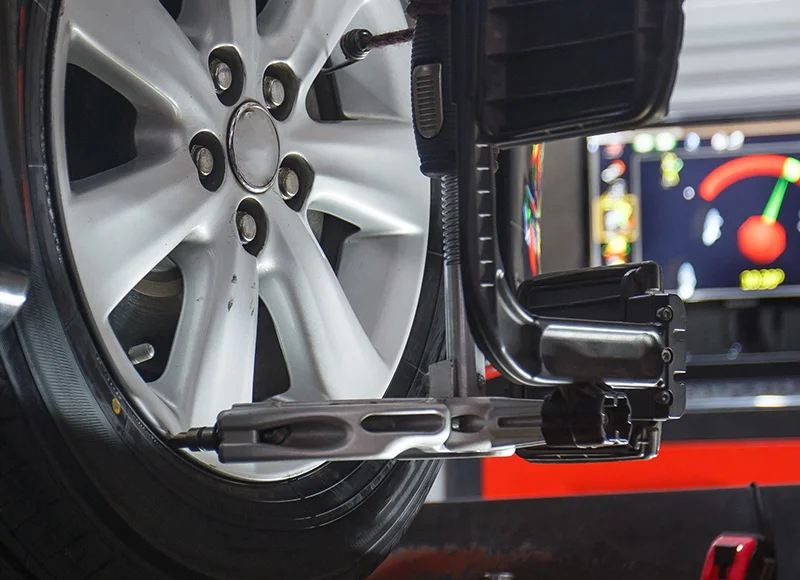
We utilize computerized alignment racks with high-definition digital cameras that capture millimetric readings of your vehicle's angles without touching or scratching alloy wheel rims.
Genuine Motorcraft Replacement Parts
If our inspection uncovers worn tie rod ends, loose ball joints, or damaged sway bar links, we install genuine Motorcraft and Ford OEM components engineered to original factory durability standards.
Convenient Riverton Service Center
Located at 1601 North Federal Boulevard in Riverton, our dealership offers comfortable customer amenities, quick check-in, transparent vehicle inspection reports, and easy online scheduling.
Frequently Asked Questions: Wheel Alignment in Riverton, WY
How often should I get a wheel alignment in Riverton, WY?
Most automotive manufacturers recommend having your wheel alignment checked once every 12 months or every 10,000 to 12,000 miles. However, because of the demanding rural roads, gravel surfaces, and severe winter potholes across Fremont County, we recommend an alignment check twice per year or whenever you install new tires or complete seasonal tire changeovers.
What is the difference between a wheel alignment and tire balancing?
Wheel alignment adjusts the mechanical angles of your suspension so the tires roll straight and flat against the pavement. Tire balancing compensates for weight distribution variations within the tire and wheel assembly by adding small wheel weights to eliminate rotational bouncing and vibrations at highway speeds. Both services complement each other for optimal ride smoothness and tire longevity.
Does lifting or leveling my Ford truck affect wheel alignment?
Yes. Installing a suspension lift kit, leveling spacers, or aftermarket shocks alters the operational geometry of your control arms, steering linkages, and drive axles. Any suspension modification requires an immediate computerized wheel alignment to restore safe caster and toe specifications and prevent severe inner tire wear.
Why does my vehicle pull to one side even after installing new tires?
New tires provide maximum tread depth and road grip, which can actually make pre-existing suspension misalignment more pronounced. If your vehicle pulls to one side after new tire installation, uneven camber or caster angles are causing the vehicle to pull. An alignment should always accompany new tire installations to safeguard your tire investment.
How long does a computerized wheel alignment take at Fremont Ford Riverton?
A standard computerized wheel alignment typically takes approximately one hour. If our technicians detect seized adjustment hardware, worn suspension components, or if your vehicle requires specialized electronic steering angle sensor recalibration, additional time may be needed to complete the service properly.
How do I schedule a wheel alignment appointment at Fremont Ford Riverton?
You can easily schedule your service appointment online through our website scheduling portal or by calling our service department directly at (307) 240-3115. Our service center is conveniently located at 1601 North Federal Boulevard in Riverton, Wyoming.
*Wheel alignment adjustments, suspension component inspections, and sensor recalibrations are subject to vehicle condition and manufacturer specifications. Additional parts or labor may be required if suspension linkages, tie rods, or adjustment eccentrics are seized, damaged, or worn beyond safe operating limits. Ford, Motorcraft, F-150, Super Duty, Explorer, Expedition, Bronco, Escape, and Ford Co-Pilot360 are registered trademarks of Ford Motor Company. Contact the Fremont Ford Riverton service department at 1601 North Federal Blvd., Riverton, WY 82501 or call (307) 240-3115 for complete service details and appointment availability.