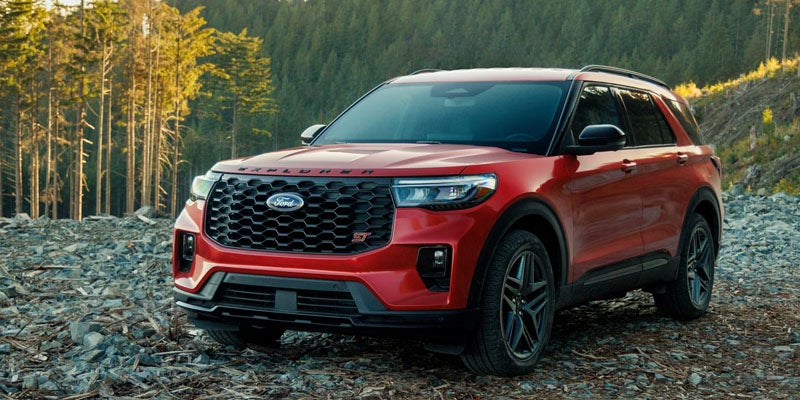


2026 Ford Bronco 4 Door. Photo: Ford. Which 2026 Ford Bronco Model Fits Families Best? Active outdoor families evaluating midsize SUVs must carefully consider their daily trail demands, cargo requirements, and towing needs. The 2026 Ford Bronco 4-Door delivers heavy-duty body-on-frame architecture built to conquer harsh wilderness trails, steep ascents, and demanding payloads. Equipped with a standard 2.3L EcoBoost engine generating 300 hp and 325 lb-ft of torque, this full-size adventure vehicle provides substantial low-end pulling force when negotiating high-altitude passes. A maximum towing capability of up to 3,500 lbs allows drivers to pull ski boats, travel trailers, or recreational equipment without straining the drivetrain. In contrast, drivers seeking an efficient daily driver for urban commutes and quick errand runs may prefer the compact Ford Bronco Sport. Built on a unibody platform, the Sport comes standard with a 1.5L EcoBoost engine producing 180 hp and 200 lb-ft of torque, with an available 2.0L EcoBoost engine on select trims delivering 250 hp and 280 lb-ft of torque. While the Bronco Sport offers agile handling and easy parking in tight spaces, the larger Bronco 4-Door remains the definitive choice when packed with heavy outdoor gear, camping supplies, or full passenger loads on unpaved dirt roads. Selecting the ideal model depends on whether your lifestyle prioritizes everyday efficiency or extreme off-road durability. Comparing Trim Capabilities Across the 2026 Ford Bronco Lineup The full-size 2026 Ford Bronco 4-Door and compact Bronco Sport serve distinct roles across the Ford lineup, reflected in their engineering and capability levels. The full-size model relies on a heavy-duty body-on-frame platform weighing between 4,700 lbs and 5,300+ lbs depending on equipment, compared to the lighter 3,400 lbs to 3,700 lbs unibody chassis of the crossover edition. Across multiple trim options—including the Big Bend, Outer Banks, Heritage Edition, and Badlands—the full-size 4-Door configurations deliver increasing levels of off-road hardware: Capability Feature Ford Bronco 4-Door Ford Bronco Sport Platform Type Heavy-Duty Body-on-Frame Unibody Crossover Standard Engine 2.3L EcoBoost (300 hp / 325 lb-ft) 1.5L EcoBoost (180 hp / 200 lb-ft) Available Engine 2.7L EcoBoost V6 (330 hp / 415 lb-ft) 2.0L EcoBoost (250 hp / 280 lb-ft) Transmission 7-Speed Manual / 10-Speed Automatic 8-Speed Automatic Max Towing Capacity Up to 3,500 lbs Up to 2,200 lbs Payload Rating Approx. 1,100–1,370 lbs Approx. 1,000–1,170 lbs Transfer Case Advanced Dual-Range 4x4 Single-Speed 4x4 (Dual-Clutch Rear Drive on Badlands) The larger chassis of the full-size Bronco enables heavy towing alongside an advanced dual-range transfer case with low-range gearing. Drivers can choose between a 7-speed manual transmission with crawler gear or a 10-speed SelectShift automatic, delivering heavy-duty endurance over grueling terrain. Conversely, the lighter crossover utilizes an 8-speed automatic system tailored for highway efficiency and light trail use. Evaluating Cargo Capacity and Interior Dimensions for Trail Gear Inside the 2026 Ford Bronco 4-Door, generous cabin proportions provide ample room for passengers and bulky outdoor gear. Drivers enjoy 43.3 inches of front headroom and 43.1 inches of front legroom, while back-seat passengers sit comfortably with 41.1 inches of rear headroom and 36.3 inches of rear legroom. Total passenger volume exceeds 108 cubic feet, giving five occupants plenty of room during extended road trips. Furthermore, removable roof sections and quick-release side doors allow you to open up the cabin completely, stowing protective gear bags on board when exploring open trails. Conversely, the 2026 Ford Bronco Sport delivers a compact footprint that maximizes dedicated rear utility. Offering roughly 29 cubic feet of luggage space behind the second row, its interior features built-in tie-down rings and available wash-out rubberized flooring that simplifies cleanup after fishing or camping trips. Front occupants receive 40.8 inches of headroom and comfortable seating layout, yielding an overall passenger volume of roughly 104 cubic feet. Comparing Off-Road Capability and Engine Performance Conquering high-elevation terrain demands reliable mechanical hardware and strong powertrain output. The 2026 Ford Bronco 4-Door comes equipped with a standard 2.3L EcoBoost engine pushing out 300 hp and 325 lb-ft of torque, with an available 2.7L EcoBoost V6 pushing output to 330 hp and 415 lb-ft of torque. Drivers desiring maximum control across loose gravel and steep inclines can opt for the standard seven-speed manual transmission equipped with an ultra-low crawler gear ratio, or choose the available 10-speed SelectShift automatic transmission. By comparison, the crossover-based Bronco Sport offers responsive performance via its 8-speed automatic gearbox. When driving along challenging mountain trails, the structural distinction between these two vehicles becomes immediately apparent. The Bronco 4-Door relies on a traditional body-on-frame platform built to withstand severe chassis twisting. Trims like the Badlands 4x4 include advanced off-road hardware such as a front stabilizer bar disconnect, front and rear locking differentials, and an aggressive 35.5-degree approach angle. For those planning to tackle extreme boulders or deep snow, adding the available Sasquatch Package introduces high-clearance suspension, 17-inch beadlock-capable wheels wrapped in 35-inch all-terrain tires, and an impressive 38.2-degree approach angle. Select trims also offer the HOSS suspension configurations featuring FOX Internal Bypass Dampers, which absorb harsh hits at higher trail speeds. While the Bronco Sport maintains up to an 8.8-to-9.4-inch ground clearance on Badlands models and handles paved highways smoothly, it lacks the heavy-duty low-range transfer case required for extreme rock crawling. Fuel Economy Expectations and Driving Range When planning long-distance travel across open highways, balancing efficiency with total driving distance becomes essential. The 2026 Ford Bronco Sport serves as the more fuel-efficient option, with 1.5L models delivering an EPA-estimated 25 city / 29 hwy MPG. The performance-focused 2.0L Badlands trim offers 21 city / 27 hwy MPG. For drivers who spend substantial time commuting or making frequent urban trips, these figures lead to noticeable fuel savings over time. In comparison, the 2026 Ford Bronco 4-Door prioritizes rugged performance and mechanical strength, which reflects in its fuel efficiency ratings. Standard 2.3L configurations yield an EPA-estimated 18 city / 21 hwy / 19 combined MPG. Upgrading to the trail-focused Badlands 4x4 or Sasquatch-equipped trims with wider all-terrain tires adjusts efficiency ratings to 17 city / 18 hwy / 17 combined MPG. Despite lower overall fuel ratings, the full-size Bronco 4-Door balances frequent refueling stops with its massive 20.8-gallon fuel tank capacity. On standard trims, this high-capacity tank enables an estimated total driving range of up to 395 miles on a single fill-up. The Bronco Sport provides maximum efficiency for regular commuting, but the full-size Bronco 4-Door guarantees the endurance needed when traveling long distances between remote refueling points. Advanced Technology Features and Safety Systems Every 2026 Ford Bronco 4-Door comes equipped with modern trail technology and intelligent cabin software designed for rugged outdoor driving. Center stage is a standard 12-inch LCD capacitive touchscreen powered by SYNC 4 software, supporting wireless Apple CarPlay and Android Auto integration. Drivers can easily manage navigation, media, and vehicle settings using natural voice controls. Directly ahead of the steering wheel, a matching 12-inch digital instrument cluster displays critical telemetry, including real-time pitch and roll angles, 4x4 system status, and individual tire pressures. Upgrading to optional equipment bundles, such as the Lux Package, elevates cabin technology significantly. This configuration adds a 360-Degree Camera system with front off-road spotter views, allowing drivers to navigate tight boulders and narrow trail ledges with confidence. Premium audio is handled by an available 12-speaker B&O Sound System by Bang & Olufsen, tuned to deliver clear sound even when driving with open roof panels. Driver confidence is reinforced by a broad suite of protective technologies. Standard active safety equipment includes Pre-Collision Assist with Automatic Emergency Braking, auto high-beam headlamps, and a backup camera with dynamic grid lines. Selecting higher equipment groups introduces a Lane-Keeping System, adaptive cruise control with stop-and-go capability, and a Blind Spot Information System (BLIS) with Cross-Traffic Alert. Warranty Coverage and Long-Term Maintenance Support Every new 2026 Ford Bronco 4-Door includes factory-backed protection designed to safeguard your vehicle against unexpected repair costs. Standard coverage features a 3-year/36,000-mile bumper-to-bumper warranty along with a 5-year/60,000-mile powertrain warranty. Factory paint finishes are warranted for 36 months or 36,000 miles, and corrosion protection extends to 60 months or 60,000 miles. Owners also benefit from emergency assistance during the first 36 months or 36,000 miles of driving through Ford Roadside Assistance, providing support for flat tires, battery jump-starts, or lockout services. Frequently Asked Questions About 2026 Ford Bronco 4-Door Capabilities Is the 2026 Ford Bronco 4-Door worth choosing over the Bronco Sport? For drivers requiring an authentic body-on-frame platform, removable top panels and doors, up to 300+ hp, and a maximum tow rating of 3,500 lbs, the full-size model provides superior off-road capability and muscle. However, daily commuters prioritizing highway fuel efficiency and compact maneuverability may find the smaller Bronco Sport crossover to be a better fit. Can you detach the doors and roof on a Ford Bronco Sport? No, the Bronco Sport features a permanent unibody roof structure and standard steel doors. Open-air driving capability with removable doors and modular roof panels is exclusive to full-size models like the Bronco 2-Door and 4-Door.
Preparing Your Truck for Wyoming Hunting Season
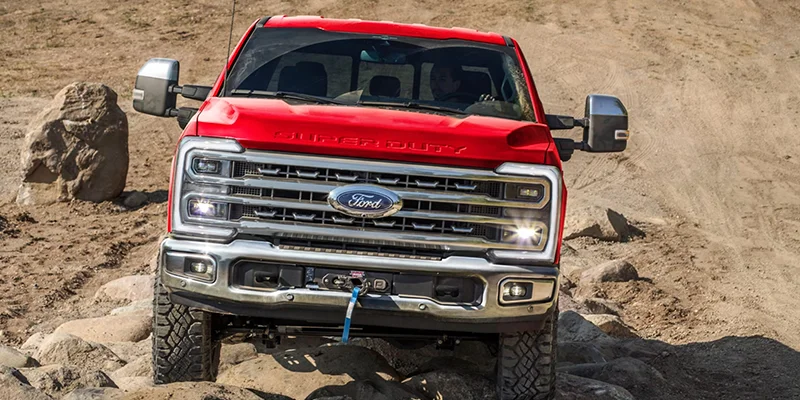
Fall big game seasons bring Wyoming sportsmen into remote backcountry terrain across the Wind River Range, the Absarokas, and Fremont County public lands. Whether packing wall tents over Union Pass, hauling utility trailers up toward Dubois, or scouting two-tracks along Beaver Rim, vehicle reliability makes the difference between a successful hunt and getting stranded far outside cellular coverage. 1. Cold-Morning Battery Output & Electrical Health Autumn mornings in western Wyoming routinely plummet into the single digits before dawn. Frigid temperatures thicken motor oil and increase engine cranking resistance while simultaneously reducing 12-volt automotive battery output by nearly half. A weak battery that cranks without issue in August can easily leave you stranded at a mountain trailhead in October. Our factory-trained technicians perform digital conductance tests to measure Cold Cranking Amps (CCA) and reserve capacity. We also verify alternator charging output, clean lead-sulfate deposits from cable terminals, and check starter draw before you head into remote areas. Backcountry Tip: Cold temperatures slow the chemical reactions inside your battery. Testing Cold Cranking Amps in early fall identifies weakening cells before sub-freezing mornings cause starting failures. 2. Backcountry Traction: All-Terrain Tires and Spares Sharp river cobble, jagged mountain shale, and sudden snow squalls put immense stress on pickup tires. Standard passenger-rated highway tires often lack the ply strength and sidewall puncture defense needed for rocky Forest Service and BLM access roads. Load Range E Ply Rating Heavy-duty 10-ply rated all-terrain tires feature reinforced sidewall compounds that protect against sharp rocks and trail debris while delivering biting traction through greasy mountain mud. Cold Pressure Adjustments Tire air pressure drops roughly one pound per square inch for every ten-degree drop in outside temperature. Proper cold inflation maintains uniform tread contact and prevents rim bead separation. Underbed Spare Winch Check A puncture forty miles down a two-track requires a matching full-size spare. We verify proper spare tire inflation and confirm the underbed hoist lowers freely without seized cables. 3. Four-Wheel Drive Powertrain & Differential Fluids Tackling mountain switchbacks, muddy creek crossings, and rocky shelf roads demands reliable four-wheel drive engagement. Seasonal transfer case and differential fluid inspections prevent severe gear wear under heavy load. Water, mud, and trail grit can enter axle breather tubes during shallow river crossings, causing lubricant breakdown. We inspect front and rear axle lubricants, drain and replenish transfer case fluid to OEM Motorcraft specifications, and confirm electronic locking differentials and shift-on-the-fly transfer motors engage smoothly across 4-High and 4-Low gear ranges. 4. Towing Readiness: Brakes, Suspension, and Cooling Hauling tandem-axle trailers loaded with side-by-sides, wall tent poles, and camp provisions places major demands on your truck's braking and cooling systems. Descending mountain passes requires steady stopping power and responsive trailer brake control. Brake Friction & Fluid We measure brake pad thickness on all four corners, inspect rotor faces for thermal scoring, and test brake fluid moisture levels to prevent pedal fade during long downhill descents. Chassis & Suspension Heavy bed payloads stress ball joints, tie rod ends, shocks, and rear leaf spring packs. We check for worn bushings, loose linkages, and leaking shock absorbers before you tow. Coolant Freeze Protection High-elevation freezes demand proper antifreeze concentration. We test coolant specific gravity to protect engine blocks down to thirty degrees below zero while checking hoses and belts. 5. Bed Utility & Pro Power Onboard Mobile Energy Modern Ford pickups function as mobile basecamps throughout the fall hunting season. Spray-in bedliners protect truck beds against gouges from metal fuel cans, heavy coolers, and hunting gear, while integrated tie-down cleats keep heavy loads anchored over rough washboard trails. F-150 and Super Duty models equipped with Pro Power Onboard supply exportable electrical outlets directly in the truck bed. This built-in power system runs battery tenders, meat processing tools, portable air compressors, and wall tent lighting without needing to pack a separate gas generator into the backcountry. Schedule Your Fall Hunting Prep at Fremont Ford Riverton Located on North Federal Boulevard in Riverton, our factory-trained service technicians and Quick Lane Tire & Auto Center provide routine oil changes, tire rotations, brake service, and multi-point safety inspections. Every vehicle purchased through our dealership group includes Fremont Care coverage for ongoing maintenance peace of mind. Schedule Service Online Explore OEM Accessories